China’s Congress Is Over: Has PBOC Just Let The Yuan Go?
BY TYLER DURDEN
TUESDAY, OCT 25, 2022 – 08:45 PM
By Ye Xie, Bloomberg Markets Live reporter and analyst
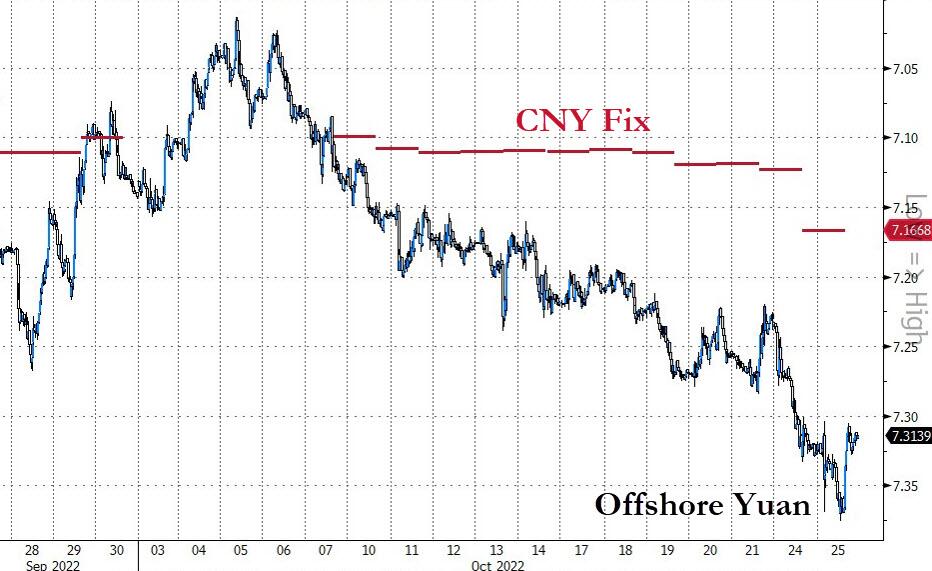
Until Tuesday, the People’s Bank of China had been fighting against yuan depreciation via strong fixings. However, the defense crumbled a bit as soon as the C*******t Party Congress was over. The fixing on Tuesday wasn’t as strong as it was in previous sessions, even as the yuan fell to the lowest since 2007.
Is that a fluke or has the PBOC showed more tolerance for yuan depreciation? Wednesday’s fixing will tell us if the PBOC has indeed decided to “lie flat.”
In the days before and during the Party Congress, the central bank effectively kept the fixing unchanged around 7.1 per dollar, putting a temporary floor under the currency. The fixing surpassed analysts survey by Bloomberg by a record last Thursday, suggesting a strong willingness to defend the yuan.
But the depreciation pressure didn’t go away. As a result, traders pushed the yuan almost to the weaker end of its 2% limit relative to the fixing Monday. On Tuesday, the PBOC finally loosened its grip, allowing the reference rate to fall by the most since June. It was still about 5 bps stronger than analysts surveyed, but the deviation was the smallest in a week. As if on cue, the onshore yuan weakened to 7.31 per dollar, the lowest since December 2007, and fell to the lowest against the basket in more than a year.

Advertisement
______________________________________________________
That marked a change in the PBOC’s strategy, according to Jens Nordvig, founder of Exante Data. It used to be that the PBOC forced the markets to converge to its fixing. Now, the markets are leading the central bank in dictating the currency’s moves.
“The fact that they have been trying to create a big gap between fixing and spot, and then have to move to spot, rather than the other way around, is the key,” said Nordvig. “We are breaking big levels in the process.”

Why such a shift?
The PBOC is “more out of bullets than in the past,” said Nordvig. The central bank doesn’t want to burn through its foreign reserves, and it cannot raise interest rates to reduce the depreciation pressure. In addition, the authorities have already closed a lot of capital-account holes. In other words, the PBOC is running out of “easy” ways to control the yuan, he said.
It’s not that the PBOC has completely stopped resisting the depreciation pressure. Right before the PBOC released its fixing on Tuesday, the central bank tweaked a policy to make it easier for companies to seek funding offshore, a move that could potentially add more dollar supply to the onshore market.
But these are only token measures of support for the currency. Brad Setser, a senior fellow at the Council on Foreign Relations, tweeted: “Until China proves otherwise, it is effectively engaged in a controlled depreciation.”
Advertisement
______________________________________________________
Source: Zero Hedge
______________________________________________________
If you wish to contact the author of a post, you can send us an email at voyagesoflight@gmail.com and we’ll forward your request to the author (if available). If you have any questions about a post or the website, you may also forward your questions and concerns to the same email address.
______________________________________________________
All articles, videos, and images posted on Dinar Chronicles were submitted by readers and/or handpicked by the site itself for informational and/or entertainment purposes.
Dinar Chronicles is not a registered investment adviser, broker dealer, banker or currency dealer and as such, no information on the website should be construed as investment advice. We do not support, represent or guarantee the completeness, truthfulness, accuracy, or reliability of any content or communications posted on this site. Information posted on this site may or may not be fictitious. We do not intend to and are not providing financial, legal, tax, political or any other advice to readers of this website.
Copyright © Dinar Chronicles